


Higher education grant management helps colleges and universities pursue funding, administer awards, track spending and meet their reporting requirements. However, these institutions face unique challenges related to funding and grant management. This guide explains common types of higher education grants, management stages, institutional challenges, best practices and the tools that support the grant life cycle.
Higher education institutions have access to four main grant types. Exploring these avenues helps unlock diverse grant opportunities that support various aspects of educational life.
Federal grants for higher education go toward research, student aid and institutional programs. This funding is provided by organizations within the federal government and is often the largest source of funding for higher education institutions. These grants also come with the strictest reporting guidelines and the highest level of competitiveness.
Several federal agencies that award higher education grants include the National Institutes of Health (NIH), the National Science Foundation (NSF) and the U.S. Department of Education (ED). The NIH Research Project (R01) Grant program, which funds independent research projects, is one of the most well-known federal grants. Federal grant application processes may have specific requirements that change periodically, and applicants should check with funding agencies for current application procedures.
State governments provide grants that support education priorities within their jurisdiction. Because they serve a smaller pool of institutions, they may be less competitive. State grants may vary widely by state, but may include opportunities like:
Private grants come from charitable foundations and can support programs that are aligned with the foundation’s mission. For example, grants can enable schools to upgrade equipment and technology for more efficient and helpful administrative services, from academic advising to class registration to campus security. These technological and infrastructural improvements can enhance student satisfaction and improve overall academic success.
Businesses and corporate foundations provide grants as part of their social responsibility initiatives. The grants they offer are usually in line with their industry. For example, a STEM-focused company may offer grants to higher education institutions that fund research in the field or support diversity in programs.
These grants may also have a particular geographic focus. For example, a company might award grants to institutions within its service area, whether that be a single state or a particular region. Depending on the company, grants provide funds for research, scholarships or community engagement programs.
Grants are an essential source of income that schools can use to finance various initiatives. When facing the unique challenges of managing grants, keeping the benefits and purposes of grants in mind can highlight their importance for schools.
Some key functions of grants for higher education institutions include:
Grant funding supports faculty and student research that institutional budgets may not fully cover. Professors often have responsibilities that include conducting and publishing research, which grants can help fund. Students can use undergraduate and graduate research grants to explore their fields and deepen their understanding. Grants enable universities to foster academic excellence, encouraging new and groundbreaking work.
Colleges and universities can use eligible grant funding to build or renovate campus facilities. These initiatives can support expanding student populations with more available classrooms and living spaces, further enhancing student life. It can also make an institution more attractive to potential future students.
The administration also needs support to help meet student needs. Grants can enable schools to upgrade equipment and technology for more efficient and helpful administrative services, from academic advising to class registration to campus security. These technological and infrastructural improvements can enhance student satisfaction and improve overall academic success.
Grant funding ensures campuses and administrative teams have the financial resources they need to complete essential functions and support their students and faculty. In educational centers, research and academic needs are a priority that grant funding can enhance.
Grant management is the process of tracking and organizing resources, actions and budgets throughout the entire grant life cycle. Grant management has three distinct phases in most cases:
Pre-award management covers the work required to identify grant opportunities and write a grant proposal with all essential information to secure the funds. You must determine what your school needs and the resources your project will require. Understanding your current needs is an essential aspect of pre-award grant management because it will impact the success of other stages.
In this stage of grant management, the received funds are allocated to their designated projects, and the funded work begins. Some grantors will give funds to projects in stages, requiring you to complete the early deliverables of projects before receiving other portions of the budget.
This aspect of grant management will include ensuring projects stick to their budget and meet deadlines. Developing detailed reports for grantors and other stakeholders can help streamline the budgeting process and ensure your institution utilizes funds effectively.
Post-award management covers various activities that happen after the award is issued. These may include implementation, spending, compliance, reporting and closeout. Administrators can review project outcomes to see if initial goals were reached or determine progress toward completion. They will also look over budgets to ensure spending stays within limits.
Good grant management will increase communication and visibility across the three stages, ensuring administrators and project managers know the project progress and grant status at any given time.
Because campuses are busy organizations with many independent colleges and departments receiving grant funding, grant management can become complicated and present many unique challenges.
High application volumes and strict eligibility requirements make many higher education grants highly competitive. Competitive grants are ones where grantors have not yet determined who will receive the funding, requiring organizations to review applications and proposals from interested institutions and choose the ones that best fit their qualifications and eligibility standards.

While schools can find available grants from federal and state agencies and private programs, the volume of applicants and strict eligibility standards can make it challenging to receive funding. Many grantors require comprehensive records and proposals, so schools must gather resources and data from across departments and projects to prove they need and can responsibly handle funds. They might have to show historical records that demonstrate the need for funds or past projects funded by grants.
Within individual schools, there might be multiple departments and initiatives competing for the same funds. Universities and administrative teams must determine priorities and approve projects to decide where to allocate funds across campus. Internal competition can make grants more scarce and challenging for research teams, underfunded departments and smaller projects.
Data silos can prevent administrators from seeing complete, current grant information across the institution. At most academic institutions, colleges and departments are responsible for housing, managing and tracking their data in separate systems. While this can help manage access controls and data volume, it can create unique challenges when institutions need to pull from several departments to create a more comprehensive picture of campus activities.
Data silos can create problems for higher education institutions managing their grants. Grant management requires institutions to track fund usage and campus activity across the grant management life cycle. When all information is separate, administrators must request data from each department and wait for their teams to compile information and send it back to the requester. Additionally, departments can misunderstand requests and return the wrong data, causing the process to repeat.
Inconsistent reporting makes it harder to monitor spending and demonstrate performance that meets grant requirements. When data is siloed with individual departments, administrative teams have a harder time maintaining and creating comprehensive records. Inefficient methods can make it hard to receive accurate and timely data from departments and researchers, while the volume of fund applications can cause comprehensive records that are difficult to organize and identify.
Even when departments have access to all essential data, they might have insufficient reporting and tracking methods. They might have several projects and initiatives within their college or department that receive funding, from individual professor research and the implementation of new technology to renovations and expansions. Information can get muddied and lost, causing problems for overall institution reporting and tracking.
This challenge can create hardships for schools across the fund management life cycle. Without current data on how departments are performing or using funds, it can be challenging to maintain or find funding from grantors who require transparency for compliance. Schools must submit financial reports to show how they used funds and upheld their end of contracts with their grantors.
Limited visibility can prevent departments from understanding which funds are available and how they can use them. Lack of clarity can come from poor communication methods at institutions or from the grantors themselves.
On the individual level, professors and researchers might be unaware that there is funding available to them. When their operations depend on affording research teams, equipment and supplies, research might come to a halt if teams are unaware they have a grant budget.
Alternatively, a lack of visibility and clarity can also lead to overspending. When teams think they have more room in the budget, it can lead to more complications later. Other projects might get cut, or schools might have to apply for continuation grants to meet their outcomes and deliverables.
Higher education institutions must account for eligible faculty and staff compensation when developing grant budgets. Nonprofits often use volunteers to help streamline operations, making it easier to budget for other necessary elements, but colleges and universities have employees and researchers who need paychecks. Grants can help cover the costs of extra labor and research compensation when starting new projects on campuses, but proposals and applications must include these factors in the budget.

Some types of compensation your school might encounter when working with a grant-funded project include:
Creating a comprehensive and detailed budget in the planning and application phases can prevent your university or college from encountering unaccounted costs and going over budget.
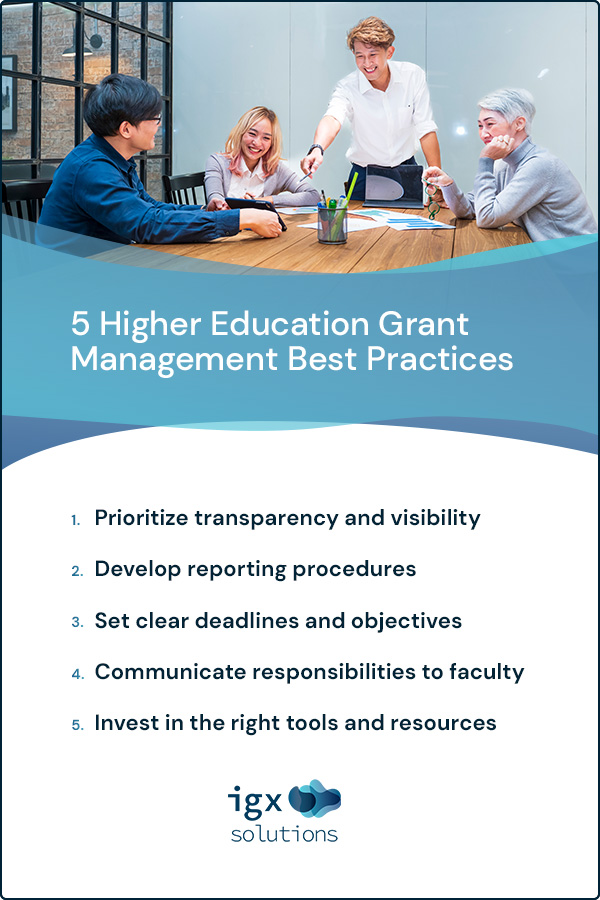
Understanding what strategies your school can implement can help you better manage your budget and pursue funding opportunities.
Transparency and visibility help colleges and universities coordinate grant budgeting, reporting and decision-making across departments. Although each department functions independently, they should work together during the application stage to accurately determine their budgets and needs.
A centralized solution that stores all information in one platform can help higher education institutions organize and access data from other departments more easily for more informed decisions and proposals. Access permissions can ensure that only individuals who need to view and use data can log in to different department datasets, but centralized data streamlines communication and collaboration efforts across departments.
Centralized solutions can also make data more reliable, ensuring the teams preparing grant budgets have access to the most recent and accurate information. When administrators access another department’s data from a centralized platform, they know there isn’t another, more recent version of the dataset.
Access to data from other departments and colleges in your institution can also help administrators identify areas that might benefit from grant funding. For example, if grades are low in one college, institutions can allocate more funds to that college to bring more student and professor resources that can support better learning and teaching.
Regardless of whether you adopt a centralized platform, your administration can also increase visibility and transparency with comprehensive reporting procedures across projects and initiatives. When you know what your researchers and colleges are spending and how they are using funding, you can better budget the remaining funds and accurately communicate with your school.
Whether your funding goes toward researchers or several departments, establishing reporting processes can keep all teams accountable throughout grant fund use. When teams make purchases, they can submit requests or spend reports to fund management teams. Both parties should keep records of their reports and budget spending throughout operations.
When your school has comprehensive records and reports on fund use, you can strengthen future grant funding opportunities. You can streamline continuation grant applications with records that show what you have accomplished and where you need more funding. With reports and historical data, you can demonstrate to your grantors that you upheld your contract to build more positive relationships.
Setting clear objectives and deadlines helps your institution align available grant funding with realistic project priorities. While grants can offer comprehensive funding, they are finite. You might have countless projects your school wants to achieve, but your budget will determine how much you can reasonably accomplish with your desired grants.
Before applying, your administrative teams can set objectives and priorities for the various projects around campus and how long they will reasonably take. Having a comprehensive plan before receiving grants shows potential grantors that you can manage your time and funds, increasing their trust in you.
Clear responsibilities help faculty members contribute to institution-wide grant management. Professors can support communication and collaboration even when they aren’t conducting research or actively using grant funds.
Before starting projects, you can streamline faculty involvement by carefully outlining what they can do. For some, it might include reporting regular student and faculty performance data to help identify areas of improvement around campus. For professors who are more involved, you might include information about submitting research proposals or procedures for hiring student research assistants.
Because they work with students and other faculty daily and often use various campus services and facilities, professors can be valuable sources of insight that you can use to drive impactful changes. They can offer valuable feedback on where improvements are needed while assessing the progress of various current projects. Like other processes, having outlined instructions can optimize feedback, so administrative teams can store and use the feedback effectively.
Colleges and universities need the right equipment and resources to support everyday operations. Grant management platforms can help you track essential information and compile reports for streamlined processes that optimize efficiency and compliance.
At IGX Solutions, our IntelliGrants® IGX software solution is a centralized platform designed to help organizations manage grants across the life cycle, from research and applications through project completion and financial reporting. When applying for grants, grant software for universities allows you to view your application’s status, so you can streamline school operations while waiting for approval.
After receiving funding, IntelliGrants IGX will receive and store all your performance and spending data in one place so administrators and project managers can oversee operations and adjust plans to reflect available budgets and better meet your deadlines. When you can stay within your budget and finish projects on time, you can foster stronger relationships with your grantors.
Higher education institutions can manage grants with spreadsheets, accounting systems, project management software or dedicated grant management software.
Spreadsheets offer an accessible way to track basic grant details such as deadlines, budgets and contact information. Shared documents can also help your team draft proposals and store application materials. These tools may suit a department managing a small number of straightforward grants.
Manual files may become harder to coordinate as your grant activity grows. Different departments may keep separate versions, use inconsistent naming systems or update records at different times. Administrators must then compare files and request missing information before they can assess institutional grant activity.
Accounting platforms help institutions record transactions, monitor spending and prepare records and financial statements. They can show whether a project remains within its budget and provide data for financial reporting.
These kinds of systems usually focus on financial activity rather than the complete grant life cycle. Your staff may need to transfer information between the accounting platform and separate grant records, which can increase administrative work and make current grant information harder to locate.
Project management platforms can assign tasks with established deadlines and show progress toward project milestones. Built-in communication tools also help faculty members, admin staff and finance teams exchange updates easily.
These platforms support collaboration, but are not necessarily designed around grant requirements. Your institution may need to create its own workflows for application reviews, award amendments, fund disbursements and compliance reports. General-purpose project management software may also lack the role-based permissions and historical records needed for grant oversight.
Using dedicated grant management software brings grant processes and data into one platform. Your institution can use it to create applications, coordinate reviews, monitor awards and create or store reports. Centralized records provide authorized users with consistent access to up-to-date information throughout the grant life cycle.
IntelliGrants IGX provides configurable tools for higher education grant management:
The most notable difference between IntelliGrants IGX and one-size-fits-all tools is its configurable design. Your institution can select a customized implementation or use preconfigured roles and workflows for a faster startup. Custom branding allows the applicant experience to reflect the institution.
The web-based platform also offers multifactor authentication and user-level permissions to control access to grant information. By bringing applications, spending data, communications and reports together, IntelliGrants IGX reduces reliance on separate files and disconnected tools. Your higher education team gains a consistent view of grant activity while retaining processes that match your institution’s needs.
Using a higher education grant management guide can help colleges and universities identify beneficial strategies as they approach the grant application process, but you also need the grant management software for higher education. Our IntelliGrants IGX software provides the technical support and transparency that universities and colleges need to effectively manage and use their grant funding to improve their campuses.
IntelliGrants IGX has an adaptable configuration that you can change to fit your needs for easier implementation and use. This platform flexibility makes IntelliGrants IGX excellent for schools because you can use it across departments and applications to support grant-funded initiatives across campus. With its centralized platform, you can get an overview of your spending and projects, or you can easily access more specific information to assess independent performance.
Request a live demo today or preview the platform to discover how IntelliGrants IGX can support your funding needs.
Watch the Free Demo Call Us at (888) 534-5879


