


Grantmaking is complex work. Juggling federal, state, local and private dollars means monitoring different funding sources while tracking their deadlines and unique compliance requirements. All that information can quickly lead to delays and paperwork pile-ups.
Although the digital age has given us more tools, it can also complicate grant work. In fact, research has shown that overly complicated requirements make agencies less cost-effective. Agencies must track funds, maintain accurate reporting, stay transparent and ensure efficiency throughout the grant life cycle.
Despite these challenges, careful planning and support can simplify the process. With the right tools, agencies can reduce administrative work while improving grant funding source tracking.
Funding tracking goes beyond ledger balancing. Grantmakers must manage the life cycle of every dollar, from intake to award and final closeout. Every phase of the grant life cycle requires documentation and interdepartmental coordination. Add in multiple funding streams in the same programs, and the complexity grows. That’s where multi-source tracking comes in. The goal is for every dollar to be traceable back to its origin and outcomes at any moment.
Multi-source tracking is about maintaining fund-source integrity while achieving program outcomes. Grants must adhere to their purpose and compliance rules, even when they support activities that overlap with other awards. That means tagging expenditures, tracking drawdowns and maintaining maintenance-of-effort records that align with program requirements.
Tracking crosses departments, too. Program teams focus on performance metrics, while finance staff handle allocations and reimbursements. Meanwhile, compliance officers ensure everything meets government requirements. Multi-source tracking means all these groups can access the same data without duplicating work.
Grantmakers dealing with multiple funding streams often struggle to stay on schedule. Programs often rely on braided funding, which occurs when separate grants contribute to a shared goal, like infrastructure renewal, while each source maintains its compliance requirements. In some cases, agencies can blend funds. They merge streams into a single budget, but at a risk — misapplied expenses can risk compliance for all the involved programs.
Braided funding is often the only solution that different funding sources allow. However, different sources mean that every funding stream has conflicting rules. They all have their own:
Agencies often attempt to manage these standards with spreadsheets and shared drives. Over time, they develop sprawling, complicated spreadsheets. Duplicate data, missing attachments and outdated versions pile up as the spreadsheets multiply. Without centralized oversight, staff find and organize files more than work on program outcomes.
Tracking multiple funding sources is easy once your agency has the right tools and processes. A strong structure lets grantmakers work proactively and efficiently. Use this seven-step framework to keep your organization accurate and compliant across multiple funding streams.
Step one is translation. Before funds are awarded or obligations noted, map each program’s legal and administrative requirements into data elements. Document federal statutes, agency guidance and any state-level addenda that influence how funds are spent or reported. For each requirement, define the:
For example, if a federal program limits travel costs, those conditions should become structured fields. Defining requirements in the system gets you ready for automation down the road.
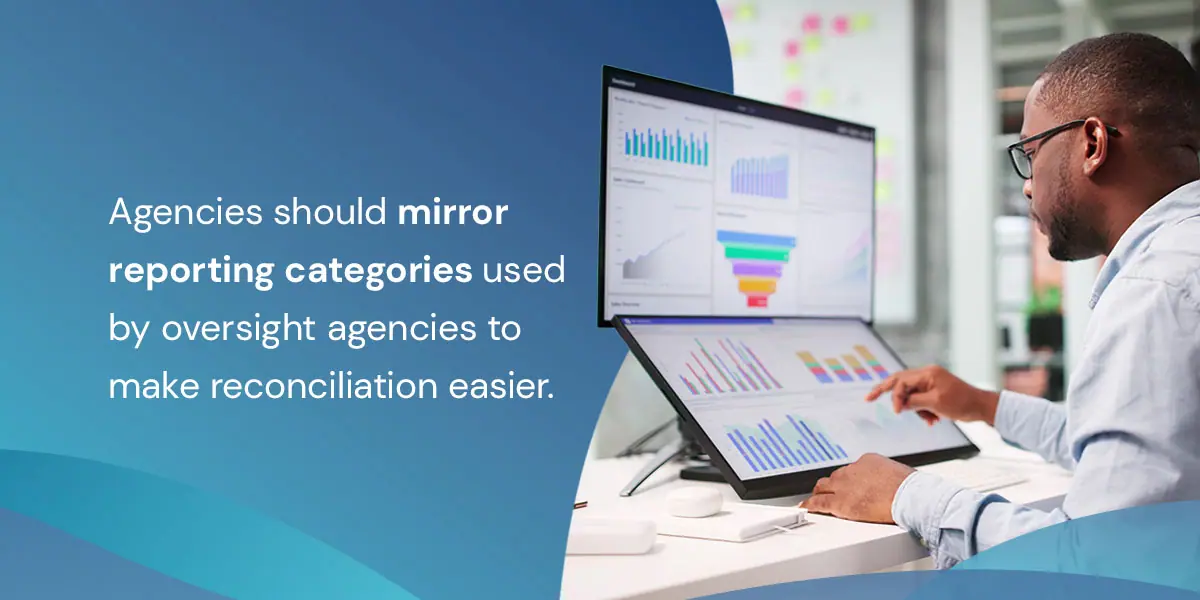
A strong financial structure ensures agencies can trace every dollar back to its origin. Create a chart of accounts that uses fund-source tags to distinguish each grant, cost category and program objective. From there, pair tags with line-item coding for the activities, subrecipients and allowable expense types. Agencies should mirror reporting categories used by oversight agencies to make reconciliation easier. This financial structure becomes the backbone of your funding management, and it keeps everyone accountable.
Disjointed systems are one of the biggest barriers to accurate reporting. Integrate your core data sources and subrecipient management portals for easier tracking. Finance, HR, payroll, procurement and other major systems should connect. When someone enters a purchase record, it should reach every relevant report. That way, the team minimizes redundancies and data entry errors.
Integration also gives compliance officers real-time visibility into spending, while program managers can see performance progress. Everyone can quickly access relevant data without requesting manual updates or chasing down siloed data.
Instead of waiting for auditors to find errors, catch them when they’re entered. Use tools with automated validations to check each transaction of activity against funding rules. Validations will confirm allowability, verify dates, apply spending caps and flag concerns immediately. Teams can correct issues before approval, saving time on corrective actions. Plus, it protects your agency from compliance issues without increasing staff work.
Grantmakers need to prove where funds went and what they accomplished. Use a centralized repository for collaboration and storage. Users can attach invoices, contracts, correspondence and performance at the transaction or award level. Staff can easily access relevant information and track grant progress.
Software with intuitive dashboards connects your financial and outcome data. This format simplifies problem flagging and improves response times. With everything in one system, teams spend less time hunting for documents and can work more efficiently.
Successfully managing multiple funding sources depends on protecting data integrity. Keeping your funding requires agencies to remain transparent about their usage. Build a data governance policy to keep data transparent and compliant.
Grantmakers should know where information originates, who owns it and how it changes. Agencies must establish naming conventions and version histories for all key data fields. Data governance keeps your team audit-ready and shows exactly where data comes from. When you can trust your data and version history, your team can make better decisions for each grant program.
Too often, closing out grants becomes a last-minute scramble for documents. Standardize agency closure and reviews to make the process easier and more accurate.
Establish recurring internal checks monthly or quarterly. Teams should review expenditures, reconcile variances and document explanations before reporting deadlines. Structure workflows with assigned reviewers and timestamps to help with accountability and consistency further.
When it’s time to submit, the system should already hold pull-ready outputs like performance visuals and audit trails. Standardized close processes ensure every funding source is backed with clear documentation that fits with funding requirements.
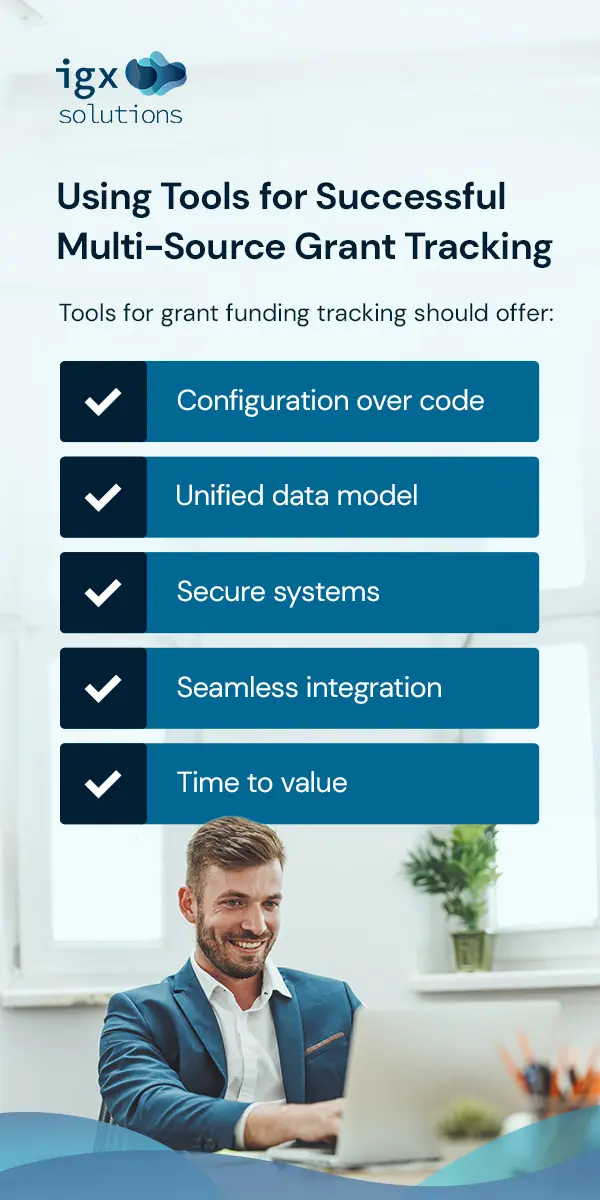
Centralizing information and automating validation requires effective technology. Grant tracking tools should do more than just offer lots of features — they should adapt to an agency’s workflows and compliance needs. Effective multi-source tracking requires a solution that connects different parts of the grant process without adding complexity. Tools for grant funding tracking should offer:
Part of knowing how to easily manage grants from multiple sources is understanding the data. The right key performance indicators (KPIs) and dashboards give leadership a real-time view of funding source performance. A strong system tracks budget versus actuals by fund source, showing teams where obligations and expenditures stand. It also highlights key financial indicators like reimbursement lag. This feature helps agencies catch potential compliance risks early.
Tracking KPIs helps, but agencies also need to know how spending affects outcomes. Use dashboards that connect program results to the specific dollars that funded them. This feature allows agencies to show how each source achieves results. Tying expenditures to impact gives you the tools to make data-driven changes and demonstrate success to stakeholders.
Reporting should be fast and consistent. Time spent looking for data and putting it in the proper forms slows agencies down. The right tools let teams generate on-demand packets for auditors in seconds. Users can prepare visual summaries for presentations and automate audit reports. This ensures all submissions are fully traceable.
The more reliable your structures, the easier it is to handle multiple finding streams. With the right tips, your agency can stay ahead of competing deadlines and inconsistent reporting requirements:
Here are some answers to frequently asked questions about managing grant funding:
Track funding sources using fund-source tagging, automated validation and centralized documentation. Each transaction should be coded by its funding stream from the start. A grant management system can make this process seamless and automatic.
Create a compliance matrix that maps every program’s unique rules against shared data fields. Combine this with validation systems, and you can manage multiple funding sources and stay compliant.
You should store contracts, purchase orders, time and effort reports, correspondence, and invoices alongside the related transaction. To avoid confusion, keep everything in the same system as expenditure tracking.
If your team manages more than a few grants or handles funds from several agencies, you need a dedicated grant management system. Advanced platforms will consolidate data and automate validation. Use software to simplify reporting and make managing multiple grants easier.
File grants in reverse-chronological order for easier organization. Put the most recent information on top and older files beneath. This way, your organization follows the order in which you’re expected to submit documents.

Leave slow, disconnected funding management behind. With IntelliGrants IGX, grantmakers gain a unified environment for all their financials, performance data and documentation. The platform’s configurable workflows and intuitive dashboards reduce manual work and keep funding cycles on track. Use IntelliGrants IGX to easily track every dollar while meeting unique funding requirements.
Take the next step and see how easy multi-source grant management can be. Book your live demo today or check out a preview of our solution and explore how IGX Solutions can help your agency simplify grant management.


