
Building Your Healthcare Organization’s Grant Program From Scratch: Strategic Planning and Setup

Building Your Healthcare Organization's Grant Program From Scratch: Strategic Planning and Setup

If you work in a healthcare organization, you already know the mission comes first. Patient care and community impact tend to take every ounce of energy your team has. Then, grants enter the picture.

Grants can open doors to new programs, expanded services and better resources. However, when your grant work lives in spreadsheets, email threads and shared drives, it can start to feel like you’re constantly playing catch-up. 

Below, we explore how to build your healthcare organization’s grant program from scratch so it feels effective and manageable.

Understanding the Healthcare Grant Landscape

Grants help you do more of what your organization is already trying to do. You can fund services that communities need, improve access to care and support programs that might not be possible through operating budgets alone.

The tricky part is that grant management is rarely just one person’s job. It typically involves finance, program leaders, compliance, leadership and sometimes external partners. A simple process can get complicated fast if the information is scattered or the steps are unclear.

Common Grant Management Challenges in Healthcare

When healthcare organizations manage grants manually or across disconnected systems, the same pain points tend to show up again and again.

These challenges cause the most stress:

  • Information that lives everywhere: Grant details end up split across spreadsheets, inboxes, shared folders and different people’s notes, which makes it harder to get the full picture quickly.
  • Continuous reporting pressure: Many grants come with strict reporting requirements. Missing a detail can create issues during monitoring or audits.
  • A workload that pulls people away from the mission: Staff spends time chasing signatures, tracking versions and updating spreadsheets instead of focusing on programs and outcomes.
  • Limited visibility for leadership: When data is scattered, it becomes more challenging for leadership to make informed decisions.

Strategic Planning for Healthcare Grant Programs

Before you think about tools or software, you want a clear plan. Strategic planning keeps your grant work aligned with what your organization actually needs.

Conducting a Needs Assessment

A needs assessment is about slowing down and being honest about what your organization needs most. Many organizations start with a structured review of gaps and priorities.

  • Service gap review: Identify areas where patients or communities need more support and where your current resources are falling short.
  • Operational priority check: Look at what leadership is already prioritizing, like access to care, mental health services or rural outreach, and see where grant funding fits.
  • Review of past grant work: Evaluate what grants your organization has applied for or received before, what went well and what created strain, like reporting burdens or unclear ownership.

For example, if your team is trying to expand a mobile clinic program but staffing and equipment are holding you back, your needs assessment might point you toward grants that support community health access and infrastructure.

Identifying Funding Priorities

Once you understand the needs, it gets much easier to set priorities. Common healthcare funding priorities include:

  • Community health programs: Funding that supports prevention, education, outreach and services for underserved communities.
  • Infrastructure and technology improvements: Grants that help with equipment purchases, facility upgrades or system improvements tied to care delivery.
  • Research and program innovation: Funding that supports pilots, studies or new models of care.
  • Workforce development: Grants that help with training, certifications and building capacity in high-need areas.

How to Build Grant Programs for Healthcare Organizations

Once your strategy is clear, the next step is building the structure behind it. Infrastructure needs to be clear, documented and consistent.

1. Define Roles and Responsibilities

Grant programs work best when responsibilities are explicit. If roles are unclear, people miss tasks or complete the same tasks by accident.
Define Roles and Responsibilities

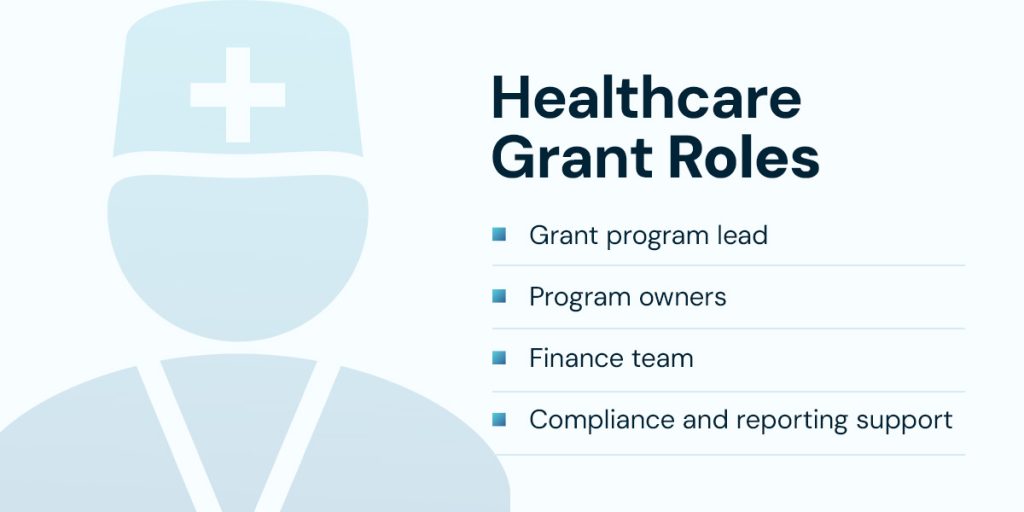
Common roles in a healthcare grant program include:

  • Grant program lead: Owns the overall process, keeps timelines moving and coordinates across teams
  • Program owners: Provides the program details, outcomes and implementation plans that grant applications usually require
  • Finance team: Tracks budgets, reimbursement documentation and financial reporting requirements
  • Compliance and reporting support: Keeps documentation aligned with requirements and ensures reporting deadlines are met

2. Develop Internal Policies and Workflows

Policies and workflows are what protect your team when things get busy. They create a shared way of working that doesn’t depend on one person remembering every step.

Policies typically cover the following areas:

  • Opportunity intake: How your organization decides whether to pursue a grant
  • Approval steps: Details who signs off on applications, budgets and submissions
  • Documentation standards: Where files live, how versions are tracked and what must be stored for reporting
  • Reporting and monitoring cadence: When reporting happens, who compiles it and how progress is tracked

Grant Management Software Selection for Healthcare

The problem isn’t that spreadsheets are “bad.” The problem is that they can collapse easily. One wrong version, one missing file or one person leaving the organization can create cascading issues. A sound grant management solution gives your team one place to manage the grant life cycle, track activity and pull reporting without rebuilding everything every time.

When you’re evaluating healthcare grant management software, you want features that reduce administrative burden and support compliance and transparency. For example, if your organization manages multiple grants across several departments, a centralized system can help you see what’s due, who owns it and what’s already been submitted without chasing updates across teams.

Key features to look for include:

  • Workflow automation: Automates repetitive steps like routing reviews, tracking approvals and assigning tasks
  • Role-based access: Gives staff access based on their responsibilities, supporting privacy and internal controls
  • Centralized grant records: Keeps applications, budgets, communications and reporting documentation tied to the same grant record
  • Built-in reporting: Ensures consistent reporting and makes it easier to deliver updates to stakeholders
  • Audit trail visibility: Tracks changes, decisions and actions, which is helpful when you need to show how and when something was completed

Implementing Grant Management Systems

Even the best software will feel frustrating if implementation is rushed. A smooth rollout happens when you take the time to align the system with your actual workflows and ensure staff feel supported.

Integrating Software Into Existing Workflows

Integration works best when you start with your current process and then improve it. Common implementation steps include process mapping, which documents how grants currently move through your organization. The next step is workflow configuration, which helps you set up workflows in the system that match your review and approval paths. Lastly, data migration planning enables you to migrate legacy data into the platform to track performance over time.

Educating Staff and Supporting Adoption

Training turns the system into something staff can actually use.

Strong adoption usually comes from:

  • Role-based training: Each team learns the workflows they’ll use, not a one-size-fits-all overview.
  • Clear internal guidance: Simple documentation explains what to do and where to find information.
  • Ongoing support: A clear path for questions and troubleshooting helps staff not get stuck.

Monitoring and Evaluating Grant Program Performance

Once your grant program is running, you want to measure how well it’s working, including both grant outcomes and the efficiency of your internal processes. Most healthcare organizations start with a handful of metrics that leadership cares about and staff can realistically track.

Common metrics include:

  • Grant usage: Whether funds are allocated and spent in accordance with the grant plan
  • Program outcomes: Results tied to the grant’s purpose, like patient reach, service expansion or program completion milestones
  • Reporting performance: Whether reporting deadlines are consistently met, and documentation is complete
  • Grant pipeline health: Application volume, success rate and how long it takes to move opportunities from intake to submission

Building a Sustainable Healthcare Grant Program With IntelliGrants® IGX

If you want a centralized platform that supports grant management from pre-application through closeout, IGX Solutions can help. Our IntelliGrants IGX platform is built specifically to streamline grant workflows, improve reporting visibility and reduce administrative burden. We give healthcare agencies a practical way to manage complex grant programs with confidence. 

Book your demo today to explore how IGX Solutions can help your agency simplify grant management.

Building a Sustainable Healthcare Grant Program With IntelliGrants® IGX

Sign up to Our Newsletter to Receive the Latest Updates on Our Products.