
Conservation grants play a vital role in promoting sustainable practices and protecting our planet’s natural resources. From agricultural innovation to habitat restoration, environmental compliance supports numerous types of conservation efforts.
Managing conservation grants can be complex due to multi-layered, often changing, federal and state compliance requirements. Replacing manual workflows and legacy systems with grant management software (GMS) makes it easier to uphold compliance when handling grant applications.
Distributing environmental funds requires your agency to navigate a complex web of environmental regulations. Understanding requirements is paramount to ensuring projects align with ecological stewardship.
The NEPA requires federal agencies and their pass-through partners to meticulously assess how proposed actions can affect the environment before deploying funds. This process ensures your agency thoroughly considers the potential impacts on natural and human environments and makes decisions that lead to sustainable outcomes.
The EPA sets strict fiduciary and management standards for environmental grants, demanding responsible oversight and accountability. Adhering to these guidelines is crucial to maintaining eligibility and demonstrating a commitment to environmental protection.
Projects involving processes that could impact air quality, such as construction or industrial activities, must comply with CAA standards and emission limits. The CAA regulates air emissions from mobile and stationary sources to protect the environment and public health.
This act often requires grantees to obtain specific air permits, such as Title V operating permits, which detail enforceable emission limitations and monitoring requirements. Grantees are responsible for adhering to all permit conditions, including regular monitoring, record-keeping, and reporting of emissions to regulatory authorities.
Grant-funded conservation projects must adhere to CWA requirements regarding wastewater discharge, stormwater management and wetlands protection. The CWA establishes the basic foundation for regulating pollutant discharges and surface water quality standards.
Projects that involve the provision of drinking water or could impact drinking water sources must comply with SDWA standards and requirements. This act regulates the nation’s public drinking water supply to protect public health.
Grantees must perform regular monitoring and reporting to ensure drinking water meets all National Primary Drinking Water Regulations for contaminants. This process includes routinely testing water sources and distribution systems and submitting findings to the appropriate regulatory bodies.
The RCRA governs the disposal of solid and hazardous waste. Grant-funded organizations that generate, store, transport or dispose of waste must comply with the RCRA’s management requirements.
Compliance includes developing and implementing comprehensive waste management plans and properly characterizing all waste streams according to federal and state regulations. Grantees must also confirm that all waste disposal methods, whether on-site or off-site, adhere to strict RCRA guidelines.
Grantees must follow strict USDA regulations if their projects involve farming, forestland management or ranching. USDA regulations are especially applicable when dealing with highly erodible land or wetland conservation. For example, grantees must avoid producing commodities on highly erodible land and wetlands.
The CERCLA addresses the cleanup of abandoned or uncontrolled hazardous waste sites. Grant-funded projects on or near hazardous waste sites must consider CERCLA implications and liability. This act also applies to projects that may inadvertently exacerbate existing contamination on a site.
Any grant-funded project involving the use of pesticides must comply with FIFRA application, labeling and safety guidelines. This act regulates the registration, distribution, sale and use of pesticides.
Compliance is an ongoing commitment that spans a grant’s entire life cycle. From initial funding announcement to the grant’s final closeout, environmental screening and monitoring are vital at every stage:
During the pre-award phase, due diligence establishes a strong compliance foundation. All applicants must submit comprehensive environmental impact data, ensuring they have identified and mitigated all potential effects.
During this phase, your agency should proactively screen applicants against federal exclusionary lists. This precaution helps your agency uphold funding integrity and avoid entering partnerships with ineligible entities.
The post-award phase requires ongoing vigilance. A high level of attention ensures your grant recipients continue adhering to environmental standards after receiving funds.
As a grantor, your agency must conduct regular site visits to monitor project progress and verify on-the-ground compliance. Milestone reporting is a structured way to track environmental outcomes. Digital record-keeping facilitates seamless final audit preparation.
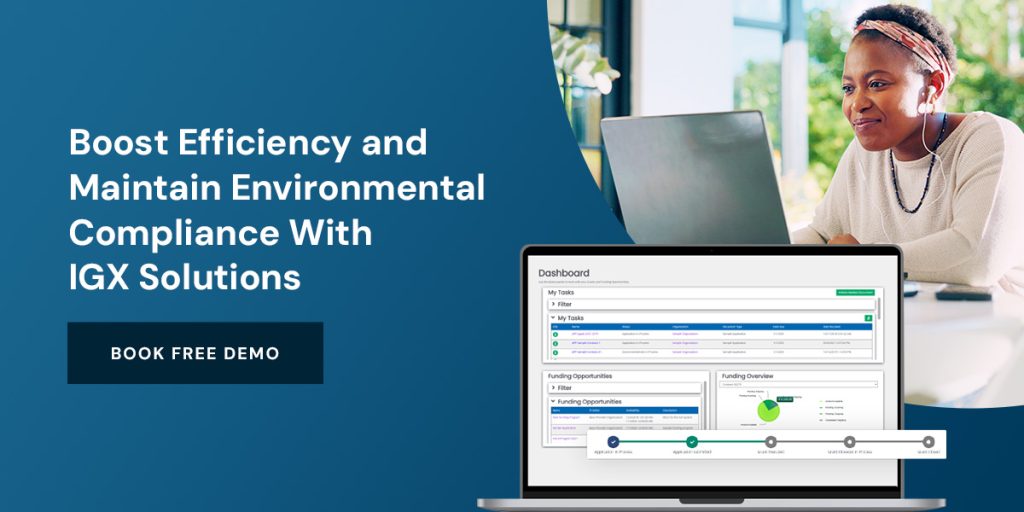
Centralized document and workflow management make it easier to maintain compliance with advanced automation features. Implementing GMS offers an alternative to manual spreadsheets and disjointed emails, significantly boosting efficiency and accountability.
This software automates workflows and creates an unalterable audit trail so your agency can save time while adhering to strict regulations. When you transition to a tech-enabled platform, you can increase the measurable impact of grant funding.
GMS enables your agency to track compliance metrics, environmental data and risk assessments on a centralized platform. Implementing this software can increase your chances of passing audits and maintaining funding, as it helps you prove compliance throughout the entire grant life cycle.
Adopting strategic practices can help your agency transform compliance challenges into opportunities for stronger oversight and faster grant processing. Navigate complex regulations and data collection with these actionable solutions:
Complying with state and federal regulations is mandatory when managing conservation grants. By embracing modern grant management solutions, your agency can streamline operations and support grantees in executing environmental projects with integrity and impact.
IGX Solutions offers robust grant management software for conservation grants. Whether you need a GMS for innovation projects or land protection efforts, IntelliGrants® IGX can help you accelerate your conservation grant processes.
Request a free demo to discover how IGX Solutions can empower your agency to navigate complex compliance landscapes with confidence.