
Grant compliance is about building trust with oversight bodies, protecting your agency’s reputation and making sure every dollar goes where it’s supposed to go. This guide breaks down what government agency grant administrators need to know to stay compliant. You’ll get a clear look at the federal and state regulations that govern grant management, all focused on ensuring compliance, navigating grant regulations and reporting at every stage.
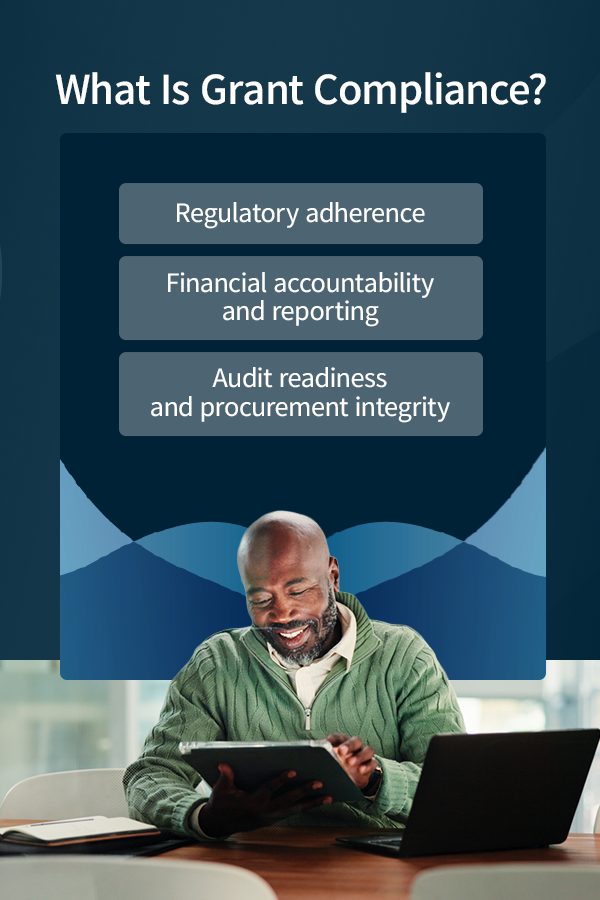
Grant compliance is about following the rules that come with federal and state funding. For government agencies that award grants, compliance responsibility extends beyond managing their own operations. They’re also accountable for how the organizations they fund use those dollars, from the day a grant is awarded through final closeout.
Your agency might be managing federal pass-through funds, state set-aside programs and direct federal awards all at the same time. Each one comes with specific regulations, funding requirements and guidelines that need to be followed.
Grant compliance for government agencies involves several key responsibilities:
Strong grant compliance processes protect your agency and the programs that depend on that money.
Federal grant compliance begins with understanding the regulatory framework governing grant administration.
2 CFR Part 200 is the general rulebook for federal grant administration. It covers these core pillars that agencies must follow:
The 2024 revision to 2 CFR Part 200 introduced several notable changes. Agencies must now take reasonable cybersecurity measures to safeguard sensitive information collected through grant programs. Recipients must notify employees of their whistleblower rights in writing. The guidance was rewritten in plain language across all subparts to make it more accessible.
If your agency is administering federal funds, 2 CFR Part 200 is the starting point. Everything else builds on it. The audit requirements under 2 CFR Part 200 specify exactly what auditors will look for when reviewing your programs.
Transparency in grant reporting is the law. The Federal Funding Accountability and Transparency Act (FFATA) and the Digital Accountability and Transparency Act (DATA Act) established clear requirements for how agencies report federal award data to the public.
For agencies, there are two key obligations. First, you need to publicly report federal award data, including grant details. This reporting obligation applies to both the agency’s own reporting and the data collected from grantees. Second, accuracy is essential. Inaccurate or late submissions undermine public accountability and can trigger additional federal oversight.
These laws essentially require agencies to maintain a clear, auditable record of how federal grant dollars are being awarded and used. Build clean data collection and reporting practices into your grant management process from day one.
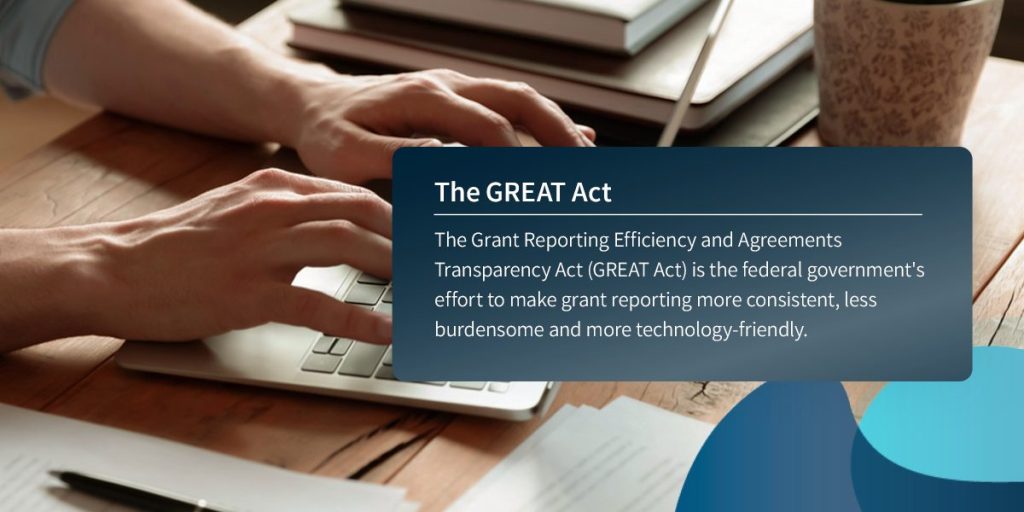
The Grant Reporting Efficiency and Agreements Transparency Act (GREAT Act) is the federal government’s effort to make grant reporting more consistent, less burdensome and more technology-friendly. It established standard data elements for federal grant reporting. You can think of it as creating a common language for collecting and sharing grant data across agencies.
Federal grant reporting is moving toward machine-readable, standardized formats. Building reporting processes around GREAT Act grant data standards can better prepare agencies to stay compliant, reduce administrative burden and avoid errors down the line.
When a state agency receives federal funding and passes it down to local governments or nonprofits, it must comply with both the federal uniform guidance and its own state-specific rules around procurement, auditing and reporting.
Compliance standards vary from state to state. What’s required in one jurisdiction may look very different in another. Staying current on your state’s specific grant management standards is just as important as knowing the federal rules.
Meeting reporting deadlines protects your agency’s access to federal funds. Late reports can trigger payment holds, and chronic delays may affect your eligibility for future awards.
When you submit accurate reports on schedule, you create a track record of reliability. Federal program officers notice agencies that consistently deliver clean, on-time submissions, and that reputation matters when you apply for competitive funding or request special considerations.
Agencies are responsible for two types of reporting, and both are equally important.
In addition to submitting their own reports accurately and on time, agencies must make sure the organizations they fund do the same. Late, incomplete or inaccurate grantee reports reflect on the administering agency and can trigger additional federal oversight or put future funding at risk.
Federal reporting is moving toward standardized, machine-readable formats. Building reporting processes around these standards can better prepare agencies for where compliance requirements are heading.
While technology creates a solid infrastructure, effective grant compliance also requires clear policies and staff training.
Document your compliance processes in writing. When your team knows exactly how to review subrecipient invoices, approve budget modifications or prepare audit responses, you reduce errors and create consistency across grant programs.
Standard operating procedures (SOPs) should cover:
Review and update these procedures annually. As regulations change or your agency adopts new systems, your SOPs should reflect current practices.
When everyone knows their role in the process, reports move efficiently through your workflow. Avoid single points of failure. If only one person knows how to generate your SF-425 data, you’re vulnerable when that person is out sick or leaves the agency. Cross-train your team so multiple staff can execute critical compliance tasks.
Audit readiness isn’t something you can build in the weeks before auditors arrive. Agencies that maintain clean, organized records throughout the grant life cycle are in a significantly stronger position when a review is scheduled, and when one isn’t.
Preparation means filing source documentation as costs are incurred, keeping subrecipient records current and making sure every transaction has a clear paper trail from approval to payment. When documentation is organized and readily accessible, audit responses take hours rather than weeks.

Juggling grant compliance across spreadsheets and emails is inefficient and leaves agencies exposed. Important documents can get lost, deadlines may get missed and audit trails become challenging to reconstruct. Each compliance area becomes significantly harder to manage without a centralized system that keeps everything in one place.
The right software handles the heavy lifting. Grant management software like IntelliGrants® IGX is built to address exactly these challenges. Automated workflows reduce the risk of human error. Centralized document storage keeps audit-ready records accessible at any time. Configurable reporting templates simplify grant reporting compliance in grant management software, streamlining both financial and performance reporting. Integrated audit trails create a clear, verifiable record of every action taken throughout the grant life cycle.
Visibility is just as important as compliance. The right system gives agencies real-time visibility into the status of their grants at every stage. The result is fewer surprises, faster responses to shifting requirements and the confidence that comes from knowing your agency’s compliance posture is solid, not just at audit time, but year-round.
Learn more about grant regulations and reporting here:
Ensuring grant compliance means following all federal and state regulations tied to each grant your agency administers, from financial management and procurement to subrecipient oversight and reporting. For government agencies, compliance responsibility extends through the entire grant life cycle, including how the organizations they fund use those dollars.
The primary framework is 2 CFR Part 200, which covers financial management, internal controls, procurement, subrecipient monitoring, record retention and audit requirements. Agencies must also comply with FFATA and the DATA Act, which govern public reporting of federal award data, and the GREAT Act, which is moving grant reporting toward standardized, machine-readable formats.
When a state agency receives federal funding and passes it to local governments or nonprofits, both the federal Uniform Guidance and state-specific rules around procurement, auditing and reporting apply at the same time. Compliance standards also vary significantly from state to state, so a one-size-fits-all approach won’t hold up. Staying current on your state’s specific requirements is just as critical as knowing the federal framework.
Grant management software supports grant reporting compliance by centralizing documentation, automating workflows and providing configurable reporting templates that streamline both financial and performance reporting. Integrated audit trails create a verifiable record of every action taken throughout the grant life cycle. This way, agencies don’t have to scramble to reconstruct documentation when auditors arrive.
Grant compliance doesn’t have to be overwhelming. IGX Solutions provides grant management software built to help government agencies manage the complexity of federal and state regulations without adding to their administrative burden.
IntelliGrants IGX gives your agency the tools to automate workflows, streamline reporting, monitor subrecipients and maintain audit-ready records throughout the entire grant life cycle. Our platform can be configured to your agency’s specific needs, so you can work with a system that fits your processes instead of being forced to adapt to rigid software.
If your agency is ready to move beyond spreadsheets and disconnected systems, our grant compliance tools can help. Schedule a demo today to see how IntelliGrants IGX supports compliant, efficient grant management.