
If you work at a transportation agency, you’re likely managing more funding than ever before. New federal investments have created real opportunities to improve roads, transit systems, ports and airports. At the same time, they’ve added layers of responsibility that stretch teams already juggling reporting deadlines, audits and stakeholder expectations.
Most agencies understand federal requirements. However, the real pressure comes from trying to manage multiple active grants at once, each with different timelines, compliance rules and reporting formats. Below, we’ll explore how to manage multiple federal transportation grants with more confidence so you can build repeatable processes for long-term success.
Federal transportation funding has expanded in recent years, especially following the passage of the Infrastructure Investment and Jobs Act. For many agencies, the act meant a welcome increase in resources, paired with a sharp rise in complexity.
Instead of one or two major awards, agencies are now managing multiple transportation grants simultaneously across programs administered by the Federal Transit Administration, the Federal Highway Administration and the Federal Aviation Administration. Each administration has its own portals, reporting schedules and documentation requirements. Keeping them aligned takes time and sustained attention.
Many agencies are also balancing formula funding alongside competitive awards, such as those from the Port Infrastructure Development Program. These programs often come with additional reporting and performance tracking expectations, adding another layer to an already full workload.
When agencies rely on spreadsheets, email reminders and disconnected folders to manage transportation grants, the work often becomes harder than necessary.
Some of the most common challenges agencies experience include:
Centralizing your grant management approach means creating a single, reliable source of truth where grant data, documents, deadlines and approvals are connected and easy to find. When that foundation is in place, day-to-day work becomes more predictable and far less stressful.
Most transportation agencies didn’t design their current workflows to handle today’s funding volume. Over time, tools were added to solve immediate needs, not long-term coordination. As grant portfolios grew, those tools remained in place. The result is a workflow that depends heavily on manual checks and individual knowledge.
Centralization doesn’t require eliminating every existing tool. It creates a structured way for those tools to work together through a unified grant management system.
In practice, core grant information is connected and accessible in one place. Each award has a dedicated record that includes funding source, award amount, performance period and reporting requirements. Financial activity and project milestones are linked directly to the grant they support, reducing confusion during reporting.
Additionally, applications, agreements, amendments and correspondence are stored alongside the relevant grant, not buried in shared folders. Roles, responsibilities and approval paths are documented so tasks don’t stall or get duplicated.
One of the biggest concerns agencies have is whether centralization will slow work down or add another layer of process. In practice, the opposite is usually true. When grant data and documentation are centralized, compliance becomes part of the workflow instead of a separate task.
Standardization is about creating shared structures that make grant activity easier to understand, track and explain across the organization.
Common challenges associated with inconsistent tracking are:

Standardization begins with agreement on core data elements. This process considers how financial data is categorized, how project milestones are defined and how progress is measured across grants.
Aligning costs classifications across grants supports clearer financial reporting and easier reconciliation. Similarly, defining how progress is tracked helps ensure performance reporting is consistent and defensible.
Shared status terms reduce ambiguity during reviews and leadership briefings. Standard time frames simplify scheduling and reduce deadline confusion.
Repeatable structures allow teams to focus on accuracy rather than formatting. Effective standardized reporting approaches include these points:
Strong controls help ensure funds are used as intended, approvals are documented clearly and compliance expectations are met without placing unnecessary pressure on staff. Clear, well-designed approval workflows create structure without getting in the way of daily work.
In many agencies, approvals rely on email threads, verbal confirmations or shared spreadsheets. While these approaches may feel efficient in the moment, they can create problems when questions arise later.
Unclear authorization records make it difficult to prove who approved a transaction and when. If approvals depend on specific individuals, work can stall if they’re unavailable. Different programs may follow different approval practices, increasing variability and risk.
Effective approval workflows reflect how agencies actually work. They provide clarity without forcing staff into rigid or impractical processes.
Audit readiness is about maintaining clear, organized records every day. Strong internal controls mean auditors can easily trace transactions from approval through expenditure. Approval histories are recorded automatically, not reconstructed later. Staff spend less time searching for records and more time validating accuracy.
Real-time monitoring is about giving teams the ability to see what’s happening across grants so they can make adjustments early. When performance and financial data are visible and up to date, agencies have time to manage grants thoughtfully rather than reactively.
Delayed visibility increases the likelihood of last-minute course corrections. Issues surface close to submission deadlines, leaving little time to respond thoughtfully. Teams may miss early warning signs tied to obligation or expenditure timelines. Without clear insight into which grants need attention, they may also focus on the wrong tasks.
Instead of waiting for periodic updates, teams can check the status of grants whenever questions arise. This kind of visibility supports better decision-making at every level of the organization.
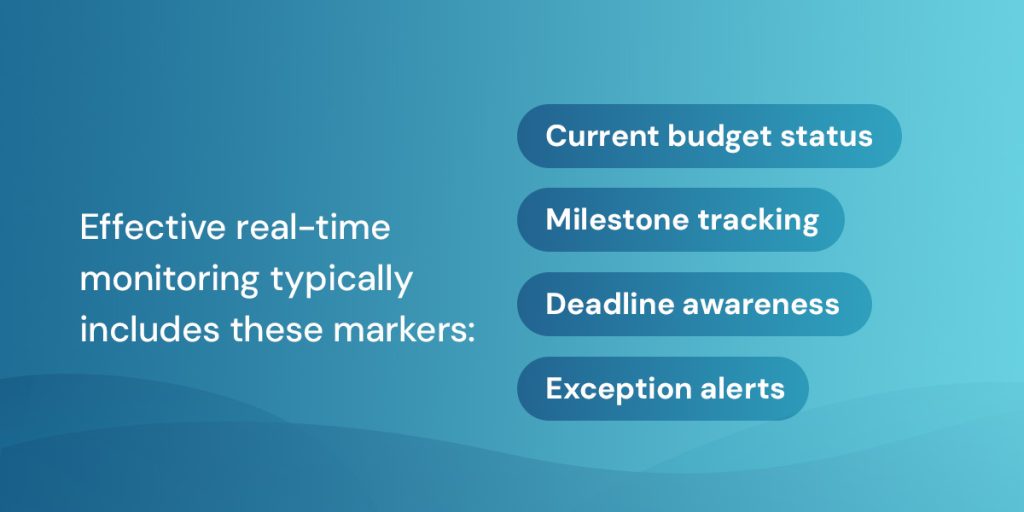
Effective real-time monitoring typically includes these markers:
When documentation and compliance practices are built into daily workflows, audits become a straightforward part of the process.
If documentation is collected only when a grant is ending or an audit begins, important context can be lost. Supporting documents may be spread across folders, email threads or legacy systems. Without documented approval histories, staff must rely on memory to explain why certain actions were taken. These realities can lead to increased stress, as audit preparation competes with ongoing grant management responsibilities.
Audit readiness improves significantly when documentation practices are consistent and ongoing. Instead of preparing for an audit as a separate effort, agencies maintain records in a way that supports review at any point in time.
Grant closeout often feels overwhelming because it’s treated as a stand-alone task at the end of the award period. In reality, closeout becomes much simpler when requirements are addressed gradually throughout the grant life cycle.
Effectively managing multiple federal transportation grants requires consistent coordination. Fragmented systems can unnecessarily complicate even the best-run programs. Grant management software offers a solution by centralizing grant data within a single, accessible platform, eliminating reliance on disparate spreadsheets.
It streamlines reporting through automated templates, maintains compliance with built-in tracking and audit trails, and provides real-time insights into funding status. This comprehensive approach allows agencies to manage grants proactively and ease the administrative burden.
Managing multiple federal transportation grants requires steady coordination, accurate reporting and constant attention to compliance. When systems are fragmented, even well-run programs can feel harder than they need to be.
If you want to move beyond spreadsheets and disconnected tools, explore how a purpose-built grant management system can support your workflows and lighten the administrative burden. IntelliGrants IGX provides a centralized platform that can optimize your agency’s transportation grant management workflow. Access intuitive features like public reporting and opportunity search that make multi-source funding straightforward.
Book your personalized demo today with IGX Solutions to see how IntelliGrants IGX can help your agency manage grants more clearly, consistently and confidently.
Linked Sources: