Grants are an excellent way for organizations and nonprofits to secure essential funding to continue offering services and resources to audiences. Unlike loans, grants benefit many types of organizations because you won’t have to repay them. Many types of organizations provide comprehensive grants that can support various budgets. Understanding what the different grant types are and where they come from can help your organization find the right funding for its needs.
4 Types of Government Grants for Nonprofits and Organizations
Depending on your needs and eligibility, organizations can apply for various federal grant types. The four most common types of federal grants for federal funding can support many causes and proposals, allowing groups to receive the essential funding they need for their grant projects. These grants are often referred to as categorical grants because they are allocated to specific programs and relatively narrowly defined activities.
Also called discretionary funding or project categorical grants, competitive grants require organizations to compete with other organizations for the same funds. Your organization will submit an application outlining your cause and budget, and the federal agency allocating funds will determine if you qualify and how much you will receive. While many regulations and factors will exist to help determine eligibility, organizations will have teams reviewing applications to make final calls.
When federal government agencies make these grants available, they will issue two types of documents to alert interested organizations — Notice of Funds Availability (NOFA) or Funding Opportunity Announcement (FOA). These notifications will outline the agency’s specific requirements for eligibility and applications, so you can determine if you fit their profile and have the resources and information to complete the application process.
Examples of competitive grants include those for music and arts programs at schools. Institutions are not guaranteed funds, but the application allows them to plead their case and argue for the program’s benefits. After review, only a limited number of schools will receive funding.
Formula grants are noncompetitive funding, meaning all eligible organizations can receive some portion of funding. How well they match qualifications will determine how much money they receive. The formula created for this type of grant will often include qualifier thresholds to help agencies allocate funds appropriately and fairly. The qualifiers might be factors such as:
Local or community population
Average income levels
The number of impacted individuals
Some common examples of this grant type include public projects, like public schooling and transportation. Various districts and localities qualify for this kind of program, but a big city with more people to serve would generally require more funding than smaller towns with a lower population density.
Pass-through grants outline the process by which organizations receive their money. The funds originally come from the federal government, but the government divvies those up to the state governments and gives them the power and authority to allocate funds from there.
State governments can use this grant type to support nonprofit organizations, local governments, and other state government agencies through a competitive or formula grant system. The states also hold the power to determine how much organizations receive.
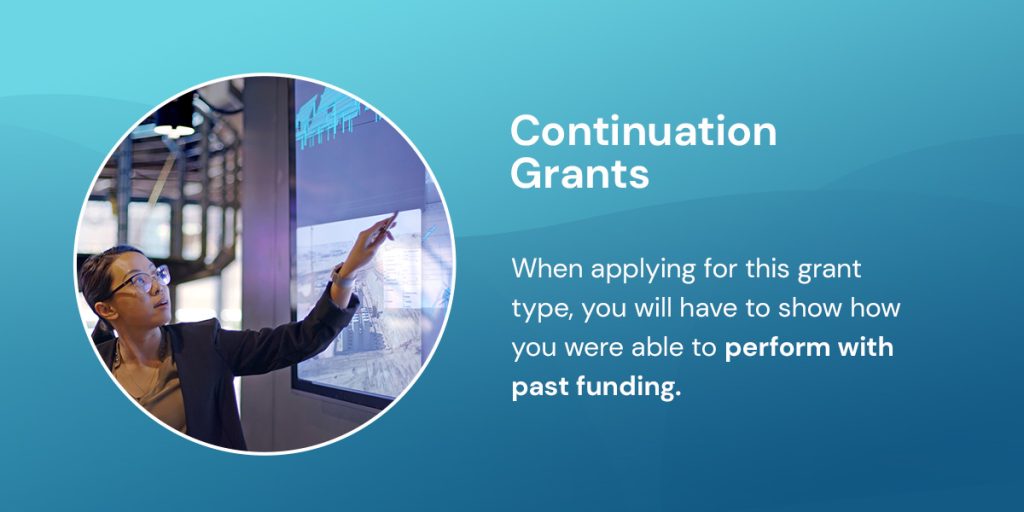
Continuation grants are for organizations that have already received federal funding and need more to complete the project. These are typically for long-term ventures that require several steps to complete. Other grants, like formula grants, automatically qualify as continuation grants so organizations can continue offering essential services to their audience.
When applying for this type of grant, you will have to show how you were able to perform with past funding. Data about your accomplishments and progress can prove that you can responsibly use federal funds while showing that you need more money.
Funding for these projects will also depend on available resources. While these grants are often noncompetitive, limited funds might decrease how much organizations receive through continuation grants. Further, your organization must remain compliant and eligible to continue to receive funds. If you stop meeting thresholds or completing specific operations, you might no longer qualify for continuation funds.
Some examples of continuation grants include human services programs. These organizations often use continuation grants to support their annual endeavors and continue helping their communities. Using data like the number of individuals served and improvement rates can show there is a continuing need for the program to help organizations secure these grants.
Other Types of Governmental Grants
While those were the four main types of federal grants, organizations and individuals can find other types of grant government funding options. While the types of federal grants are often comprehensive and supportive, organizations can diversify their options with other grants.
Block grants are another type of federal funding specifically for state and local governments. These organizations and agencies can use block grants for more general improvement projects in their localities as long as projects fit the category of the received funds.
Block grants include general categories, like public health, law enforcement, or social services. What local and state governments develop for these categories is up to them, but the money received from these funds must go to something under the designated purpose. This system allows states and local governments more flexibility and control over their projects to help their local communities and populations while still meeting some requirements and qualifications set by the federal government.
One example of a block grant is the Community Development Block Grant (CDBG) Program, which offers annual grants to states, cities, and counties. Receivers must use funds for the purpose of developing viable urban communities.
Research labs and higher education institutions require funding to complete essential research that advances innovation and technology. Organizations can apply for federal, state and private research grants to help them afford new equipment, teams and assistants, access and subscriptions to journals, conference fees, and more. These grants are often competitive, requiring researchers and teams to argue for their project’s necessity and relevance.
Some research organizations will offer grants for various subjects, allowing more organizations to find the funding they need for their lab. While science is a common subject for grants and funding, social science, education, technology, and business can find grants that support research ventures in these fields. Organizations might even fund undergraduate and graduate research, offering opportunities for students to contribute to discoveries and innovation.
These types of grants are written into legislation with the grant applicant’s name, activity, and dollar amounts. In other words, the funds are earmarked for a particular purpose. Unlike competitive grants, these grants are awarded to a specific recipient for a particular project. These grants are also referred to as congressionally directed spending or community project funding.
These funds offer several benefits, including providing direct support for urgent local needs. The funds bypass a competitive process, where critical projects could get lost and never receive funding. Congress members, as representatives of specific states, may have unique insights into their communities, which enable them to identify pressing needs.
While these grants have benefits, they also face criticism because they bypass a review process that assesses projects for their merit. They could also lead to “pork barrel” spending, where the spending benefits a small group to enhance a politician’s chances for reelection.
Types of Private Grants
Private grants are like other types, but they come from nongovernment organizations, like nonprofits and companies.
Many corporate organizations offer private grants to provide more opportunities for organizations to get funding for their various projects and initiatives. Because they have fewer regulations required for them, you might have fewer restrictions and qualifications to meet, making it easier to be eligible for these grants.
Corporate grants may also have a narrower focus, enabling companies to support their local communities. This specific focus may make it easier for smaller projects to get the funding they need. Organizations may also gain greater flexibility in how they use funds with these grant types.
Foundation grants are typically awarded by private or public foundations to projects or organizations that align with the foundation’s mission and goals. Like corporate grants, these funding sources have more flexibility in usage. These grants also have strong mission alignment. If your work aligns closely with the mission, you are more likely to receive funding and potentially establish a long-term partnership.
Private vs. Government Grants
Organizations seeking grant funding can turn to various sources, including government grants, as well as corporate and nonprofit grants. The best choice for each organization may depend on the situation. Many organizations may seek to access both public and private funding to access the amounts they need for their projects.
Government grants typically provide the largest funding amounts, which makes them more beneficial for larger and more costly projects. They also tend to offer longer project periods, providing organizations with the flexibility to complete their work over a longer time span.
The main drawback of government grants is the highly competitive and lengthy application process. Organizations seeking this funding type also tend to have stricter reporting requirements and more regulations on how they can use the funds.
Private grants benefit many organizations by allowing teams to partner with local or corporate businesses. Organizations can list their grant providers as project sponsors, allowing more marketing and advertising for private donors and grants. Recipients can also benefit because receiving private grants, paired with other financing options and federal grants, can prevent them from taking out loans they cannot repay.
Private grants also offer more diverse options to organizations. You can find private investors and providers who care about various causes and ventures, allowing your organization to apply more strategically to grants, which gives you a higher chance of receiving.
However, private grants might have fewer funds available and can still be highly competitive. Like federal organizations, corporate and private donors will publish notices online when grants open, so they can receive plenty of applications. Limited budgets that depend on company profits might decrease the amount they can spend on any given project, even if you meet their requirements.
Tips for Securing General and Federal Grant Types
When applying for federal and other types of grants, your teams should compile all essential documents in your application and submit them by the due dates for sponsors to consider your organization and cause. Various strategies can strengthen your chances of receiving the funding your organization needs to continue offering your services.
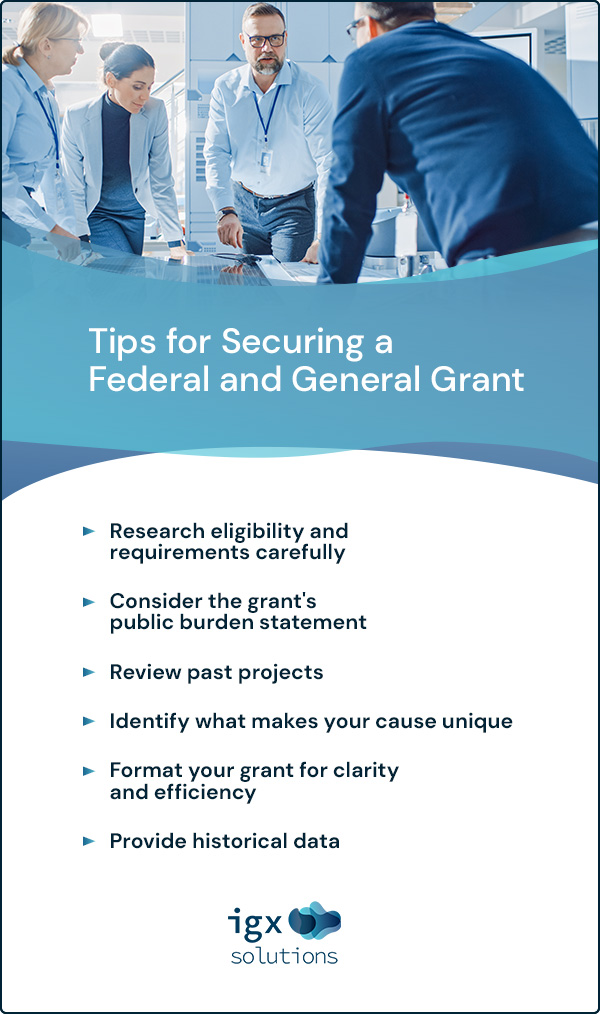
Research Eligibility and Requirements Carefully
The main reason organizations get denied grant funding is that they apply for grants they don’t qualify for. Government and private entities will carefully outline their eligibility requirements for applicants, from the essential documents to qualifying factors, like population thresholds and operation levels. Many grant providers target specific industries and applications for their grants, like science and technology or human services organizations.
When you want to optimize your chances of grant approval, you can streamline operations by limiting your applications to only those for which you meet all eligibility requirements.
Consider the Grant’s Public Burden Statement
Grants can be comprehensive, requiring several documents and proof to complete the application and prove to providers that you meet their qualifications. Most grants will include a public burden statement with their description and information. This statement will outline how much work it will take to complete a successful application and how long it will take. It can help organizations determine if they have the resources and time to submit this application to better optimize their operations and hard work.
This statement will also tell you how detailed your application must be. While some grants might just require some examples and a general summary of operations, others will need historical data, which can take more time and effort to compile. By assessing the public burden statement, you can choose grants that match your capabilities and available time.
Review Past Projects
Many grant providers choose specific types of projects to receive their grants. This grant history can create a pattern that interested organizations can use to determine if your project and organization are the right fit for approval. Grant providers and federal organizations often publish past grant recipients. You can review these databases to determine if your organization matches what they are looking for.
Referring to past funding recipients can shed more light on a grant’s requirements and qualifying factors. Reviewing past recipients can determine if your organization matches what they are looking for beyond just the baseline. You can better tailor your applications to meet their qualifications and optimize your efforts for stronger results.
Identify What Makes Your Cause Unique
Because grants have such specific qualifications and eligibility requirements, grant providers will get several applications from similar organizations. They will often look for organizations that stand out and get their attention or show they are doing something different than others. When applying for grants, especially competitive ones, you can help your application better catch the attention of reviewers by highlighting what makes your organization unique.
For example, many local governments in more rural areas will apply for funding to help support public services and projects. However, the struggles of small, rural areas are often similar to other locations, making it challenging for local governments to get attention with the same narrative proposed by other localities. Instead, these agencies can outline the specific and unique challenges that their area is facing to increase their chances of receiving funding.
When determining your distinguishing factor, consider the individuals you serve. What makes them choose your organization over others? It is likely that you provide services and care that they cannot get through other resources, making yours more unique and impactful to their daily lives.
Another way you can increase your competitiveness is to create a narrative with your application. Tell a compelling story beyond dry data to give grant providers a more nuanced depiction of your organization, operations and the individuals you help. A mix of data and storytelling can create an impactful and comprehensive application that meets eligibility standards and stands out from other applicants.
Format Your Grant for Clarity and Efficiency
Because grant reviewers have so many applications to sort through, make a better first impression by making your application and proposal concise and easy to read. When teams can efficiently review your application, they can better stick to their schedule and quickly determine funding allocation and divisions.
With a concise and clear grant proposal, you quickly communicate your point to reviewers while still including the essential details to help your organization stand out. Your format should support your application’s brevity while optimizing clarity. Details like bullet points, page numbers, a table of contents, and graphics make your application more scannable for review teams, so they can quickly find and look over the essential information they need to make an informed decision.
Provide Historical Data
Whether you are applying for a grant for the first time or a continuation grant, your past performance data can support your needs. For example, you might show how your audience has increased over the past years, helping support your argument for funds to expand your facilities, equipment or marketing campaigns. This information can provide the evidence review teams need to distinguish your organization from others while strengthening your argument.
Continuation grants often require historical data. You must prove that you are meeting the requirements needed for continued funds, like population and service thresholds. Historical data from the time since you received the first grant can show that you still need the funds to continue providing essential services or complete your project.
Streamline Grant Application and Renewal With IGX Solutions
You need the right tools and resources for grants management after applying for federal, state, or private funding for your organization. IGX Solutions offers IntelliGrants® IGX — an intuitive grant application management system you can personalize to your needs. The solution increases organizational visibility, allowing you to better track and understand grant application status and progress. Our grants management software has a centralized system that keeps all information organized in one place for increased access and streamlined operations.
Request a demo below or contact us to discover how IntelliGrants IGX can help your organization manage and secure new and continuation grants.
Can an organization apply for multiple types of grants simultaneously?
Yes, most organizations pursue a mix of government, corporate, and foundation grants simultaneously. This diversification reduces dependence on any single funding source. However, ensure your organization has the capacity to manage multiple grants if all are approved.
How do I track which grants I’m eligible for?
Use federal grant databases like grants.gov, state funding websites, foundation databases, and corporate grant listings. Many organizations use grant management software to track opportunities, deadlines, eligibility requirements, and application status.
Can grant management software help me understand different grant types?
Yes. Quality software can categorize grants by type, help you track eligibility requirements for each type, maintain compliance requirements specific to each grant type, and track application deadlines and requirements.
How does grant management software help manage multiple grant types simultaneously?
Software provides centralized tracking of all grants (different types, requirements, compliance rules), automatic alerts for reporting deadlines, budget tracking specific to each grant, documentation organization, and compliance monitoring. This is far more efficient than managing multiple grant types with spreadsheets.
Sign up to Our Newsletter to Receive the Latest Updates on Our Products.
Sign up for our newsletter to stay up to date with grant management trends and tools.