Whether you’re a nonprofit organization, health care facility, or government agency, you should prioritize a grant management process as a key component of your grant funding. Though applying for and securing a grant are complex and often time-consuming tasks themselves, you can’t neglect the management and compliance steps that follow.
If your organization is in the grant-seeking process or wants to learn how to improve its existing grants management process and procedures, follow our guide to learn more about what grant management is and what the grant management cycle entails.
Grant Management Definition
Grant management involves overseeing all activities related to a grant, particularly during the award and post-award portions of the grant life cycle. It may also include pre-award tasks, depending on the sector or the organization. Grant management entails understanding award terms and performing various administrative tasks, including ensuring compliance and evaluating project performance.
Both grantmakers and funders need to know that the grants they award are put toward their intended uses and follow their outlined requirements. Grant management helps them do just that. If you’re not effectively tracking how you’re using the funding for your reports, your financial records and grant agreement management can become an issue. With the right tools and processes in place, you can efficiently manage your grants and achieve your mission or implement a new program simultaneously.
Why Is Grant Management Important?
Grant management serves a vital role in organizations that rely on this funding for their projects. Proper management is important for the following reasons:
Compliance: Various federal, state, and local laws set guidelines that organizations must follow. Proper grant management involves tracking all requirements for enhanced compliance.
Proper fund usage: Grant funds must be used for their intended purpose. Oversight enables organizations to align spending with project goals and grant terms.
Financial tracking: Those who manage grants are responsible for building robust financial management systems, which offer transparency into fund usage.
Future opportunities: Effective management for a single grant can open up future opportunities by displaying an organization’s reliability.
Grant life cycle management ensures organizations maintain access to funds and sets them up for smooth audit processes. It can also help preserve an organization’s reputation.
What Does a Grant Manager Do?
As the title implies, a grant manager takes on the responsibilities of grant management. They oversee grant responsibilities throughout the entire life cycle. Their daily work may involve various tasks, such as:
Researching grant opportunities
Creating and managing budgets
Communicating with team members, stakeholders, and grantors
Managing records and financial data related to grants
Monitoring adherence to grant terms and regulations
Analyzing project data to support decision-making
Preparing and submitting reports to grantors
How to Manage Grants Effectively
Grant management plays a vital role in organizations that rely on external funding. Establish an effective process for grants management to streamline this task. Here are a few tips to improve your grant management:
Plan for every step: Instead of focusing solely on the next step, maintain a broad perspective, particularly noting final processes, so you can plan for them effectively within your approach to data collection.
Understand the grant agreement: This document outlines all conditions and reporting requirements. Beyond just reading it, take note of all the essential details so you can use them to guide your approach.
Implement robust tracking: From the day you receive the award, establish systems for recording financial and project data that support both internal operations and external reporting.
Monitor and report internally: While you’re required to submit reports to grantors, you should also monitor your progress internally, which can help you avoid surprises and adjust plans as necessary.
Collaborate as a team: Effective management often involves all team members working together, from financial personnel to leadership. Note each individual’s responsibilities to enhance the management process.
https://vimeo.com/779723084
Grant Management Life Cycle
A grant’s life cycle management process involves many factors. From the initial application to awarding the grant to the closeout of the program, it’s important for organizations and agencies to understand all the necessary steps involved in receiving and implementing a grant.
Let’s look at the grant life cycle through the three fundamental stages — pre-award, award, and post-award.
1. Pre-Award Stage
The first grant stage begins when funders establish and develop a funding program and announce funding opportunities. From there, they’ll advertise their grant awards to invite proposals from communities that align with their mission. For grantmakers, the pre-award stage involves creating clear guidelines for applications and collecting and reviewing applications.
During this phase of the life cycle of grants, it’s critical to double-check every aspect of your application and ensure you review the requirements for every grant you apply for, including important deadlines. Applying and awaiting an award for a grant can be a lengthy and tedious process, so you should only apply for those that fit your organization’s needs. Likewise, be sure to have a strong proposal for how the funds will be used in your agency.
On the other side, grantseekers take the following steps:
As a grantseeker, you’ll want to keep track of potential opportunities that fit your organizational goals, such as if you need funding to start a new program or initiative. To determine which grants you’re eligible for, you can search through your country’s grant database and register.
Once you identify a grant your agency wants to apply for, you can begin collecting the required information about your organization for the application. This information could include financial data, the size of your team, or explanations of proposed work.
Once you successfully fill out the application and submit it on the grant website, your agency will enter the application processing stage as you await the decision. You can generally track your application’s status by corresponding with the funding agency, though every grant application process is different.
During this grant life cycle phase, it’s critical to double-check every aspect of your application and ensure you review the requirements for every grant you apply for, including important deadlines. Applying and awaiting an award for a grant can be a lengthy and tedious process, so you should only apply for those that fit your organization’s needs. Likewise, be sure to have a strong proposal for how the funds will be used in your agency.
2. Award Stage
In the next phase of the grant life cycle, grantors and funding agencies will decide which organizations receive the awards and provide the funds. Depending on the type of grant you’ve applied for, your grant terms may vary. If your agency has applied for or been awarded several grants, it’s critical to communicate all expectations and deadlines with your entire team to properly fulfill the grant contract. This stage follows three primary steps:
Grantmakers will notify all applicants whether their applications have been approved. If your organization receives the grant, you’ll move on to the next steps in the process.
Before your agency receives any funds for your new program or project, you must work with the grantor to clearly outline the legal terms and conditions of your agreement and finalize the award with both parties signing the document. It’s wise to have legal counsel review the details of the agreement to ensure your agency has the bandwidth to meet expectations, including all deadlines, activities, and deliverables.
Once you and the grantor have completed and signed the agreement, your organization will receive the funds. From the moment the grantor disburses the funds, it’s necessary to start tracking your spending and any other details that correspond with your grant agreement.
Depending on the type of grant you’ve applied for, your grant terms may vary. If your agency has applied or been awarded several grants, it’s critical to communicate all expectations and deadlines with your entire team to properly fulfill the grant contract.
3. Post-Award Stage
The post-award stage is the longest of the three grant life cycle stages. After distributing the award, the funder will ensure compliance with the agreed terms through reporting or periodic audits, interviews, and visits. Remember that every grant and granting agency will handle the post-award stage differently, but it’s best to always be prepared by properly tracking your budget, providing proof of how your agency uses the funds, and staying on track with obligations.
Here are the three main steps of the post-award stage:
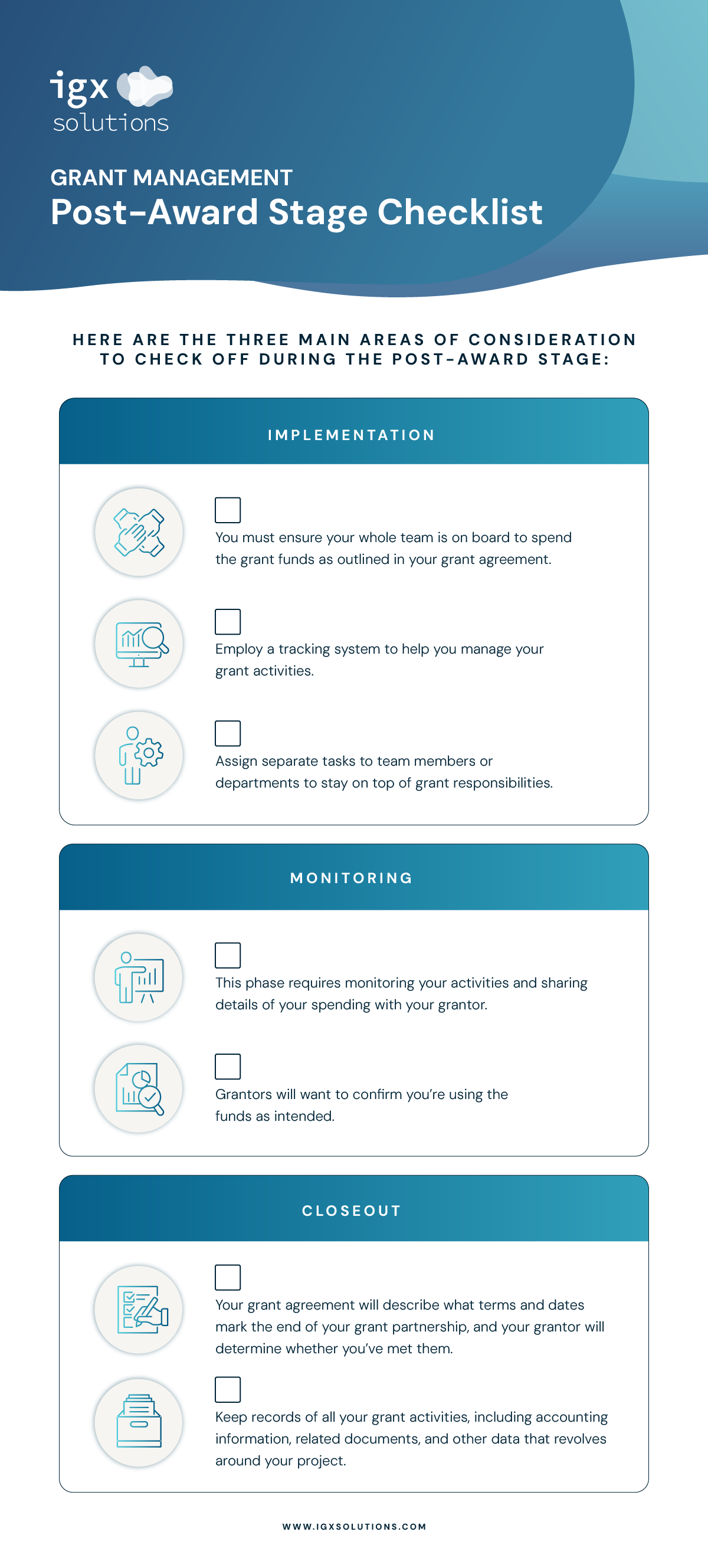
After your agency receives the funds to start your new initiative, you must ensure your whole team is on board to spend the grant funds as outlined in your grant agreement. During this step, you should employ a tracking system to help you manage your grant activities. You can also assign separate tasks to team members or departments to stay on top of grant responsibilities.
The reporting step of the post-award stage is arguably the most important. This phase requires monitoring your activities and sharing details of your spending with your grantor. Whether you communicate project updates, provide receipts, or show proof of the impact the funds have made on your mission, grantors will want to confirm you’re using the funds as intended.
Once you’ve used the funding for its outlined purpose, your agency will enter the closeout stage. Your grant agreement will explicitly describe what terms and dates mark the end of your grant partnership, and your grantor will determine whether you’ve met the requirements. As your program comes to a close, keep records of all your grant activities, including accounting information, related documents, and other data that revolves around your project. This information can be helpful for applying for future grants.
Common Mistakes Made During the Grant Management Process
The grants management process involves many tasks that require the cooperation of your entire agency. Let’s review five common mistakes organizations make during the grant management life cycle so you can make the most of the process and follow best practices:
Funders find it difficult to feel confident in the awards they provide if organizations fail to maintain plenty of evidence that they’re carrying out their intended purpose for the grant.
If your organization has paid employees, you’ll need to factor in their compensation in addition to the expenses for your project. Failing to do so can cause you to quickly exceed your original requested amount.
After receiving your funds, your agency will likely be busy juggling many responsibilities to get your project or program started. However, you must remember to keep tabs on all important grant deadlines. Using a grant management platform can help you stay on track with due dates.
Preparing and collecting internal information for your grant application can take up much of your time. If you wait until the last minute to gather financial, organizational background, or impact data, you may end up missing your submission date.
Modernize Your Grant Process With IntelliGrants®Grant Management Software
The entire grant life cycle involves many crucial tasks that can be challenging to track without the right tools and collaborative team effort. At IGX Solutions, we make grant tracking and grant program management easier for grant-funded industries, including government, education, health care, nonprofit and transportation. Our intuitive IntelliGrants platform has configurable and scalable templates to work with your organization’s unique grant process and reporting needs.
With a centralized online grant management system, your agency can produce better reporting, budgeting, and tracking of the grant life cycle outcomes to comply with your grant agreement. To learn more about how our full-service grant management solutions will streamline your processes, book a live demo or check out a preview of our solution today.
Frequently Asked Questions
What’s the risk of managing multiple grants without software?
Without centralized tracking, you risk missed deadlines, commingling funds, incorrect spending categorization, duplicate work, missed reporting requirements, compliance issues, and audit problems. Grant management software like IntelliGrants IGX dramatically reduces these risks.
What if multiple grants have conflicting requirements?
Document each grant’s specific requirements. If requirements truly conflict, contact both grantors to clarify expectations. In most cases, you can meet the most stringent requirement and exceed the others, ensuring compliance with all grants.
How do I get team buy-in for a new grant management process?
Clearly explain the benefits (reduced errors, fewer compliance issues, easier reporting, less stress, efficiency), address concerns about new systems, provide thorough training, recognize that transition periods are challenging, and celebrate early wins.
Sign up to Our Newsletter to Receive the Latest Updates on Our Products.
Sign up for our newsletter to stay up to date with grant management trends and tools.